Skip to Content
Math416Complex Variables (Lecture 11)

Math416 Lecture 11

Continue on integration over complex plane

Continue on last example

Last lecture we have:Let RR be a rectangular start from the a-a to aa, a+iba+ib to a+ib-a+ib, Rez2dz=0\int_{R} e^{-z^2}dz=0, however, the integral consists of four parts:

Path 1: aa-a\to a

I1ez2dz=aaez2dz=aaex2dx\int_{I_1}e^{-z^2}dz=\int_{-a}^{a}e^{-z^2}dz=\int_{-a}^{a}e^{-x^2}dx

Path 2: a+iba+iba+ib\to -a+ib

I2ez2dz=a+iba+ibez2dz=0be(a+iy)2dy\int_{I_2}e^{-z^2}dz=\int_{a+ib}^{-a+ib}e^{-z^2}dz=\int_{0}^{b}e^{-(a+iy)^2}dy

Path 3: a+ibaib-a+ib\to -a-ib

I3ez2dz=a+ibaibez2dz=aae(xib)2dx-\int_{I_3}e^{-z^2}dz=-\int_{-a+ib}^{-a-ib}e^{-z^2}dz=-\int_{a}^{-a}e^{-(x-ib)^2}dx

Path 4: aibaib-a-ib\to a-ib

I4ez2dz=aibaibez2dz=b0e(a+iy)2dy-\int_{I_4}e^{-z^2}dz=-\int_{-a-ib}^{a-ib}e^{-z^2}dz=-\int_{b}^{0}e^{-(-a+iy)^2}dy

The reverse of a curve 6.9

If γ:[a,b]C\gamma:[a,b]\to\mathbb{C} is a curve, then the rever of γ\gamma is the curve γ:[b,a]C-\gamma:[-b,-a]\to\mathbb{C} defined by (γ)(t)=γ(a+bt)(-\gamma)(t)=\gamma(a+b-t). It is the curve one obtains from γ\gamma by traversing it in the opposite direction.

  • If γ\gamma is piecewise in C1C^1, then γ-\gamma is piecewise in C1C^1.
  • γf(z)dz=γf(z)dz\int_{-\gamma}f(z)dz=-\int_{\gamma}f(z)dz for any function ff that is continuous on γ([a,b])\gamma([a,b]).

If we keep bb fixed, and let aa\to\infty, then

Definition 6.10 (Estimate of the integral)

Let γ:[a,b]C\gamma:[a,b]\to\mathbb{C} be a piecewise C1C^1 curve, and let f:[a,b]Cf:[a,b]\to\mathbb{C} be a continuous complex-valued function. Let MM be the maximum of f|f| on γ([a,b])\gamma([a,b]). (M=max{f(t):t[a,b]}M=\max\{|f(t)|:t\in[a,b]\})

Then

γf(z)dzL(γ)M\left|\int_{\gamma}f(z)dz\right|\leq L(\gamma)M

Continue on previous example, we have:

γf(z)dzL(γ)maxzγf(z)0\left|\int_{\gamma}f(z)dz\right|\leq L(\gamma)\max_{z\in\gamma}|f(z)|\to 0

Since,

ex2dxex2+b2(cos2bx+isin2bx)dx=0\int_{-\infty}^{\infty}e^{-x^2}dx-\int_{-\infty}^{\infty}e^{-x^2+b^2}(\cos 2bx+i\sin 2bx)dx=0

Since sin2bx\sin 2bx is odd, and cos2bx\cos 2bx is even, we have

ex2dx=ex2+b2cos2bxdx=πeb2\int_{-\infty}^{\infty}e^{-x^2}dx=\int_{-\infty}^{\infty}e^{-x^2+b^2}\cos 2bxdx=\sqrt{\pi}e^{-b^2}
Proof for the last step:
ex2dx=π\int_{-\infty}^{\infty}e^{-x^2}dx=\sqrt{\pi}

Proof:

Let J=ex2dxJ=\int_{-\infty}^{\infty}e^{-x^2}dx

Then

J2=ex2dxey2dy=e(x2+y2)dxdyJ^2=\int_{-\infty}^{\infty}e^{-x^2}dx\int_{-\infty}^{\infty}e^{-y^2}dy=\int_{-\infty}^{\infty}\int_{-\infty}^{\infty}e^{-(x^2+y^2)}dxdy

We can evaluate the integral on the right-hand side by converting to polar coordinates. x=rcosθx=r\cos\theta, y=rsinθ,dxdy=rdrdθy=r\sin\theta,dxdy=rdrd\theta

J2=e(x2+y2)dxdy=02π0er2rdrdθJ^2=\int_{-\infty}^{\infty}\int_{-\infty}^{\infty}e^{-(x^2+y^2)}dxdy=\int_{0}^{2\pi}\int_{0}^{\infty}e^{-r^2}rdrd\theta J2=02π0er2rdrdθ=02π[12er2]0dθJ^2=\int_{0}^{2\pi}\int_{0}^{\infty}e^{-r^2}rdrd\theta=\int_{0}^{2\pi}\left[-\frac{1}{2}e^{-r^2}\right]_{0}^{\infty}d\theta J2=02π12dθ=πJ^2=\int_{0}^{2\pi}\frac{1}{2}d\theta=\pi J=πJ=\sqrt{\pi}

QED

Chapter 7 Cauchy’s theorem

Cauchy’s theorem (Fundamental theorem of complex function theory)

Let γ\gamma be a closed curve in C\mathbb{C} and let uu be an open set containing γ\gamma^*. Let ff be a holomorphic function on uu. Then

γf(z)dz=0\int_{\gamma}f(z)dz=0

Note: What “containing γ\gamma^*” means? (Rabbit hole for topologists)

Lemma 7.1 (Goursat’s lemma)

Cauchy’s theorem is true if γ\gamma is a triangle.

Proof:

We plan to keep shrinking the triangle until f(z+h)=f(z)+hf(z)+ϵ(h)f(z+h)=f(z)+hf'(z)+\epsilon(h) where ϵ(h)\epsilon(h) is a function of hh that goes to 00 as h0h\to 0.

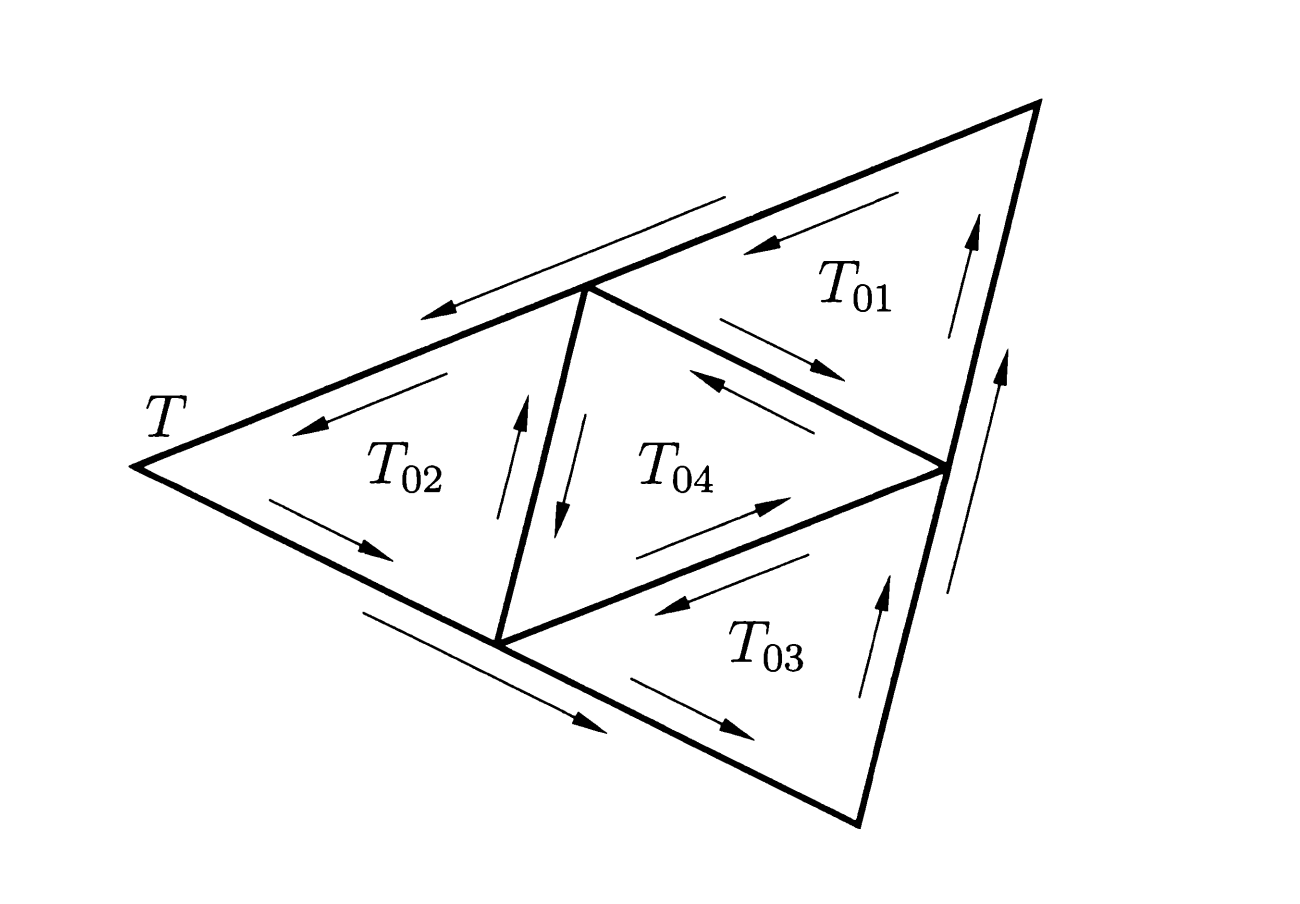
Let’s start with a triangle TT with vertices z1,z2,z3z_1,z_2,z_3.

carving a triangle

We divide TT into four smaller triangles by drawing lines from the midpoints of the sides to the opposite vertices.

Let R1,,R4R_1,\ldots,R_4 be the four smaller triangles.

For one RjR_j, Rjf(z)dz14I\left|\int_{R_j}f(z)dz\right|\geq\frac{1}{4}|I|, we choose it then call it T1T_1.

There exists T1T_1 such that T1f(z)dz14I\left|\int_{T_1}f(z)dz\right|\geq\frac{1}{4}|I|.

Since L(T1)=12L(T)L(T_1)=\frac{1}{2}L(T), we iterate after nn steps, get a triangle TnT_n such that L(Tn)=L(T)2nL(T_n)=\frac{L(T)}{2^n} and Tnf(z)dz14nI\left|\int_{T_n}f(z)dz\right|\geq\frac{1}{4^n}|I|.

Since Kn=Tninterior(Tn)K_n=T_n\cup \text{interior}(T_n) is compact, we can find Kn+1KnK_n+1\subset K_n and diam(Kn+1)<12diam(Kn)diam(K_n+1)<\frac{1}{2}diam(K_n). diam(Kn)0diam(K_n)\to 0 as nn\to\infty. (Using completeness theorem)

Since ff is holomorphic on uu, limzz0f(z)f(z0)zz0=f(z0)\lim_{z\to z_0}\frac{f(z)-f(z_0)}{z-z_0}=f'(z_0) exists.

So f(z)=f(z0)+f(z0)(zz0)+R(z)f(z)=f(z_0)+f'(z_0)(z-z_0)+R(z), we have

Tnf(z)dz=Tnf(z0)dz+Tnf(z0)(zz0)dz+TnR(z)dz\int_{T_n}f(z)dz=\int_{T_n}f(z_0)dz+\int_{T_n}f'(z_0)(z-z_0)dz+\int_{T_n}R(z)dz

since f(z0)dz+Tnf(z0)(zz0)f(z_0)dz+\int_{T_n}f'(z_0)(z-z_0) is in form of Cauchy integral formula, we have

Tnf(z0)dz+Tnf(z0)(zz0)dz=0\int_{T_n}f(z_0)dz+\int_{T_n}f'(z_0)(z-z_0)dz=0

Let en=max{R(z)zz0:z0Tn}e_n=\max\{\frac{R(z)}{z-z_0}:z_0\in T_n\}

Since diam(Kn)0diam(K_n)\to 0 as nn\to\infty, we have en0e_n\to 0 as nn\to\infty.

So

I4nTnf(z)dz4nTnRn(z)dz4nL(Tn)maxzTnRn(z)4nL(T0)2nenL(Tn)4nL(T0)2nenL(T0)2nenL(T0)2\begin{aligned} |I|&\leq 4^n\left|\int_{T_n}f(z)dz\right|\\ &\leq 4^n\left|\int_{T_n}R_n(z)dz\right|\\ &\leq 4^n\cdot L(T_n)\cdot \max_{z\in T_n}|R_n(z)|\\ &\leq 4^n\cdot \frac{L(T_0)}{2^n}\cdot e_n L(T_n)\\ &\leq 4^n\cdot \frac{L(T_0)}{2^n}\cdot e_n\cdot \frac{L(T_0)}{2^n}\\ &\leq e_n\cdot L(T_0)^2 \end{aligned}

Since en0e_n\to 0 as nn\to\infty, we have I0I\to 0 as nn\to\infty.

So

Tnf(z)dz0\int_{T_n}f(z)dz\to 0

QED

Last updated on