Math401 Topic 3: Separable Hilbert spaces
Infinite-dimensional Hilbert spaces
Recall from Topic 1.
Let be a measure on , or any other field you are interested in.
A function is square integrable if
space and general Hilbert spaces
Definition of
The space is the space of all square integrable, measurable functions on with respect to the measure (The Lebesgue measure).
The Hermitian inner product is defined by
The norm is defined by
The space is complete.
[Proof ignored here]
Recall the definition of complete metric space .
The inner product space is complete.
Note that by some general result in point-set topology, a normed vector space can always be enlarged so as to become complete. This process is called completion of the normed space.
Some exercise is showing some hints for this result:
Show that the subspace of consisting of square integrable continuous functions is not closed.
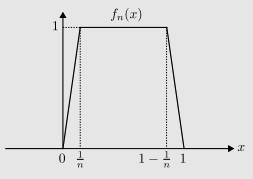
Suggestion: consider the sequence of continuous functions , where is defined by the following graph:
Show that converges in the norm to a function but the limit function is not continuous. Draw the graph of to make this clear.
Definition of general Hilbert space
A Hilbert space is a complete inner product vector space.
General Pythagorean theorem
Let be an orthonormal set in an inner product space (may not be complete). Then for all ,
[Proof ignored here]
Bessel’s inequality
Let be an orthonormal set in an inner product space (may not be complete). Then for all ,
Immediate from the general Pythagorean theorem.
Orthonormal bases
An orthonormal subset of a Hilbert space is a set all of whose elements have norm 1 and are mutually orthogonal. ()
Definition of orthonormal basis
An orthonormal subset of of a Hilbert space is an orthonormal basis of if there are no other orthonormal subsets of that contain as a proper subset.
Theorem of existence of orthonormal basis
Every separable Hilbert space has an orthonormal basis.
[Proof ignored here]
Theorem of Fourier series
Let be a separable Hilbert space with an orthonormal basis . Then for any ,
The series converges to some .
[Proof ignored here]
Fourier series in
Let .
where .
The series converges to some as .
This is the Fourier series of .
Hermite polynomials
The subspace spanned by polynomials is dense in .
An orthonormal basis of can be obtained by the Gram-Schmidt process on .
The polynomials are called the Hermite polynomials.
Isomorphism and space
Definition of isomorphic Hilbert spaces
Let and be two Hilbert spaces.
and are isomorphic if there exists a surjective linear map that is bijective and preserves the inner product.
for all .
When , the map is called unitary.
space
The space is the space of all square summable sequences.
An example of element in is .
With inner product
It is a Hilbert space (every Cauchy sequence in converges to some element in ).
Bounded operators and continuity
Let be a linear map between two vector spaces and .
We define the norm of on and .
Then is continuous if for all , if in , then in .
Using the delta-epsilon language, we can say that is continuous if for all , there exists a such that if , then .
Definition of bounded operator
A linear map is bounded if
Theorem of continuity and boundedness
A linear map is continuous if and only if it is bounded.
[Proof ignored here]
Definition of bounded Hilbert space
The set of all bounded linear operators in is denoted by .
Direct sum of Hilbert spaces
Suppose and are two Hilbert spaces.
The direct sum of and is the Hilbert space with the inner product
Such space is denoted by .
A countable direct sum of Hilbert spaces can be defined similarly, as long as it is bounded.
That is, is a sequence of elements in , and .
The inner product in such countable direct sum is defined by
Such space is denoted by .
Closed subspaces of Hilbert spaces
Definition of closed subspace
A subspace of a Hilbert space is closed if every convergent sequence in converges to some element in .
Definition of pairwise orthogonal subspaces
Two subspaces and of a Hilbert space are pairwise orthogonal if for all and .
Orthogonal projections
Definition of orthogonal complement
The orthogonal complement of a subspace of a Hilbert space is the set of all elements in that are orthogonal to every element in .
It is denoted by .
Projection theorem
Let be a Hilbert space and be a closed subspace of . Then for any can be uniquely decomposed as where and .
[Proof ignored here]
Dual Hilbert spaces
Norm of linear functionals
Let be a Hilbert space.
The norm of a linear functional is defined by
Definition of dual Hilbert space
The dual Hilbert space of is the space of all bounded linear functionals on .
It is denoted by .
You can exchange the with any other field you are interested in.
The Riesz lemma
For each , there exists a unique such that for all . And .
[Proof ignored here]
Definition of bounded sesqilinear form
A bounded sesqilinear form on is a function satisfying
- for all and .
- for all and .
- for all and some constant .
There exists a unique bounded linear operator such that for all . The norm of is the smallest constant such that for all .
[Proof ignored here]
The adjoint of a bounded operator
Let . And bounded sesqilinear form such that for all . Then there exists a unique bounded linear operator such that for all .
[Proof ignored here]
And .
Additional properties of bounded operators:
Let and . Then
- .
- .
- .
- .
- .
Definition of self-adjoint operator
An operator is self-adjoint if .
Definition of normal operator
An operator is normal if .
Definition of unitary operator
An operator is unitary if .
where is the identity operator on .
Definition of orthogonal projection
An operator is an orthogonal projection if and .
Tensor product of (infinite-dimensional) Hilbert spaces
Definition of tensor product
Let and be two Hilbert spaces. and . Then is an conjugate bilinear functional on .
Let be the set of all finite lienar combination of such conjugate bilinear functionals. We define the inner product on by
The infinite-dimensional tensor product of and is the completion (extension of those bilinear functionals to make the set closed) of with respect to the norm induced by the inner product.
Denoted by .
The orthonormal basis of is . where is the orthonormal basis of and is the orthonormal basis of .
Fock space
Definition of Fock space
Let be the -fold tensor product of .
Set .
The Fock space of is the direct sum of all .
For example, if , then an element in is a sequence of functions such that .